U-M Generative AI Use Cases

The University of Michigan is harnessing the power of AI to drive innovation across research, teaching, and administrative operations. From streamlining workflows to enhancing learning experiences, U-M faculty, staff, and students are finding creative ways to integrate AI into their daily work. This collection of U-M AI Use Cases highlights real-world applications of the university’s AI tools, showcasing the impact and potential of AI across campus.

How are you using U-M AI tools? We want to hear from you! Help grow this collection by sharing your experience. Submit your use case using the GenAI Use Case Submission Form to showcase how AI is making a difference in your department.
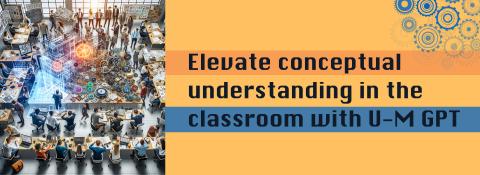
  • he image depicts a bustling classroom environment filled with students engaged in various collaborative activities. The scene is viewed from above, showcasing multiple workstations where students are actively participating in project work, many of which involve digital and mechanical components. In the center of the room, a large, holographic, and intricate 3D structure is being projected, symbolizing complex concepts being visualized with the help of AI technology.

    When it comes to transforming an engineering process from technical terms to logic, U-M GPT has become a helpful tool. U-M engineering and computer science…

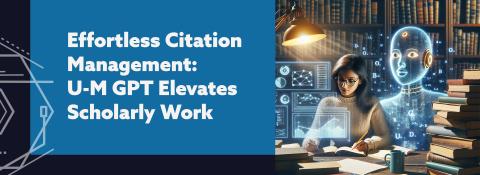
  • The image showcases a library setting where a student is sitting at a table, surrounded by books, working on scholarly research. The student, wearing glasses, is focused on writing while holographic data visualizations appear in front of them. Next to the student is a glowing AI figure, symbolizing U-M GPT, assisting with citation management and research.

    Professor Anne Gere needed an efficient method to track down citations for her book, a task that can be time-consuming and tedious. Traditional methods of citation tracking were not sufficient to meet her needs for speed and…

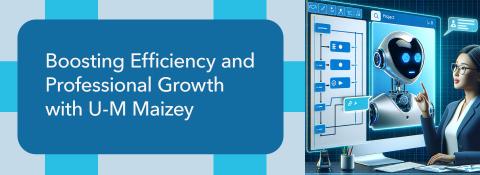
  • A professional setting where a woman, dressed in business attire, is interacting with a humanoid robot on a large digital screen. The screen displays a project flowchart, symbolizing structured, efficient work processes.

    The PMO needed to address several challenges, including the desire for a safer, more secure AI-driven solution for sensitive projects and the need for tools to aid in professional development. Team members, like Mallory Kwiatkowski,…

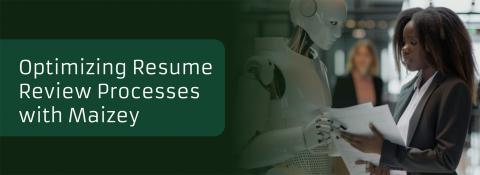
  • The image features a professional setting where a woman in a business suit is standing and reviewing a set of documents. Next to her is a humanoid robot, seemingly assisting in the process, symbolizing the collaboration between humans and AI technology.

    ITS Administration sought to efficiently rank and compare hundreds of resumes to streamline the hiring process and identify the most suitable candidates quickly.

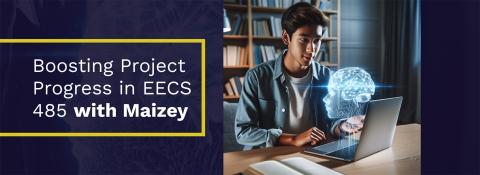
  • The image features a young student working on a laptop in what appears to be a study or workspace. On the laptop screen, a glowing holographic image of a brain is projected, symbolizing the integration of advanced technology and AI in the student's work.

    Professor Andrew DeOrio sought to supplement existing course resources like office hours and discussion forums for his large EECS 485 Web Systems course, by providing quick feedback and…

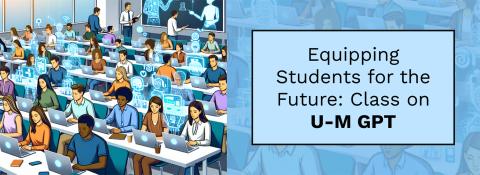
  • A modern classroom filled with students actively engaged in learning. The students are using laptops, and the classroom features digital holograms of AI-related icons and graphics surrounding the students, symbolizing their interaction with AI and technology.

    Professor Jurgens wanted to change teaching practices to prepare students for the next generation in the era of AI. Specifically, Jurgens sought to help students understand AI not as a replacement for their work but as a tool for…

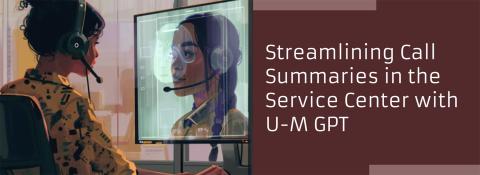
  • This image features a stylized illustration of a person wearing a headset while sitting at a desk. The individual is facing a transparent screen displaying another person, also wearing a headset, suggesting a video call or virtual interaction. The screen appears futuristic, with light elements resembling holographic displays. The overall color scheme includes soft, warm tones with subtle lighting effects.

    The U-M Service Center needed to reduce the time spent manually summarizing calls to their Tech Help line to improve efficiency and free up employee time for more critical tasks.

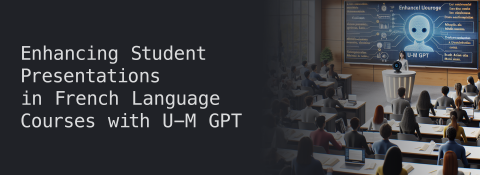
  • a classroom setting with students attentively listening to a presentation. The presenter stands at a podium with a screen behind them displaying a digital interface and a robot avatar labeled 'U-M GPT,' illustrating the integration of advanced AI in language education.

    Professor Sabine Gabaron aimed to enhance student engagement and improve the quality of student presentations in her French 280 and 232 courses. The challenge was integrating AI tools to foster creativity and individuality while…

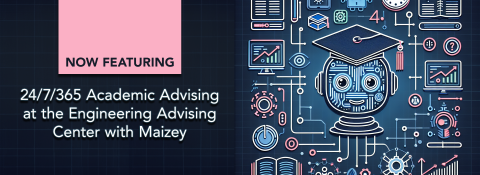
  • A stylized graphic of a robot wearing a graduation cap, surrounded by various icons representing academic and technological elements, such as graphs, books, gears, and computer screens.

    The Engineering Advising Center aimed to enhance the availability and efficiency of academic services and support for first-year and undeclared engineering students. The challenge was to provide continuous, accessible academic advising…

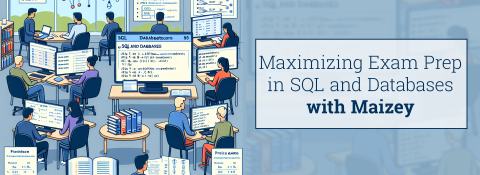
  • students seated at desks with computer screens displaying SQL queries and database structures.

    Faculty member Michael Hess aimed to address the issue of repetitive questions during office hours before exams in his SI564 course on SQL and Databases. The goal was to reduce the workload on both students and faculty by providing a…

  • a detailed illustration of a person typing on a laptop, surrounded by sheets of code and notes.

    Assistant Professor Barbara Ericson aimed to improve the learning experience for students tackling close-ended write-code problems. Traditional methods often struggle to provide personalized, real-time feedback that aligns with students…

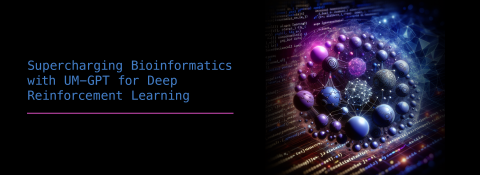
  • A vibrant, futuristic depiction of interconnected spheres and nodes, symbolizing molecular structures and data points

    A graduate student from Mich Med Bioinformatics aimed to enhance the training process of deep reinforcement learning agents by generating reward signals through sentence evaluation. The challenge was to efficiently leverage a large-…